The Disappearing Skill of Starting
When a student sits frozen in front of a blank page, we often label it as a lack of motivation or ability. But what if the problem is simpler? What if 'starting' is a skill that is quietly disappearing in the age of instant digital gratification? Explore why the hardest part of any journey is the first step—and how we can help children rebuild their 'starting muscle

Last year, I completed a personal goal: writing a book about some of the research I’ve been doing on kids and technology.
I’d thought about writing this book for a long time. I’d plenty of ideas, notes, outlines, and half-formed concepts. What I didn’t have was a clear starting point.
So the project sat there as a vague “one day I’ll figure it out.” I’d think about it occasionally, imagine how it might come together, and then put it aside again, telling myself each time that I just needed to think about it a little longer.
Eventually I realized what I was really waiting for was to feel ready. I was waiting for the moment when I’d know exactly how the book should begin and where it should go.
The problem was that moment never came.
So finally I did something much simpler. I picked up the phone and called a publisher and made a pitch.
That conversation didn’t magically solve everything. But it did something more important: it forced the project to start moving forward.
Once something begins, momentum has a way of taking over.
Looking back, the hardest part of writing a book wasn’t the writing. It was the moment before it started, the moment when I didn’t yet know how it would work. Starting is often the hardest step.
Children encounter this moment all the time when they face a new task, a difficult problem, or an open-ended assignment. The question they face is the same one I faced with my book: “Where do I begin?”
Starting Is a Skill
Initiative is often assumed to be a personality trait. Some people are self-starters and others are not.
But starting is actually a skill that develops over time through repeated experience.
Beginning a task requires tolerating uncertainty long enough to try something, even when you're not sure it will work. It means generating possible next steps on your own, and persisting until momentum has a chance to develop.
These abilities are rarely taught explicitly. More often, they develop through everyday practice.
For generations, children practiced starting constantly without anyone intentionally designing it that way. They got bored, and their boredom forced a decision.
What could I do?
What should I try?
How could I solve this problem?
Those moments of uncertainty pushed children toward action.
They invented games, explored outside, built things, and experimented with ideas that sometimes worked and sometimes didn’t.
Boredom wasn’t just empty time.
It was the starting point for initiative.
When the Prompt Disappears
As I've been exploring in recent writing, many of these moments of uncertainty are interrupted before they even have a chance to begin.
My hesitation with the book wasn't a lack of knowledge; it was a temporary loss of the 'starting' muscle. But as an adult, I had decades of previous 'starts' to fall back on. Times I’d navigated boredom or uncertainty before. Today’s children, however, are growing up in an environment where those rehearsal opportunities are being bypassed by design. We are moving from a world where we had to generate our own momentum to one where momentum is constantly provided for us.
Phones, videos, games, and algorithmically selected streams of content provide instant stimulation. The environment supplies something to do before the mind has to generate it on its own.
Boredom created internal pressure that pushed children toward action, just as hunger cues us to find food. That pressure is what made it generative. When stimulation is always available, that pressure never builds. Over time, this subtly changes behavior. When technology removes that uncertainty instantly, the brain never learns how to regulate the discomfort of a blank slate.
Children spend less time initiating activity and more time responding to stimulation that arrives from outside. This doesn’t mean children today are less capable or less motivated. But it does mean they are growing up in environments where the skill of starting is practiced less often.
What Teachers Are Seeing
A teacher raised an important concern after I spoke recently about allowing students to sit with challenges for a bit before jumping in to help.
He said that in his classroom—especially in math—when he does that, some students simply sit there and do nothing.
They don’t attempt the problem.
They don’t try a strategy.
They just wait.
At first glance, that might look like a lack of motivation or willingness to exert effort. But it may actually reflect something else. The teacher described a heavy, expectant silence. It wasn’t the silence of deep through, but the silence of a passenger waiting for a driver to start the car. When he resisted the urge to provide the first step, the students didn’t eventually start moving on their own; they just sat there. This suggests that the issue isn't a lack of math ability, but a starting reflex that has gone dormant because the expected prompt, usually in the form of a screen or specific instruction, is missing.
Productive struggle only works when children have experience starting.
If students have regularly practiced asking themselves questions like “What could I try?”, then sitting with a difficult problem usually leads to experimentation. But if that habit hasn’t been practiced as often, moments of uncertainty can trigger a different response: waiting.
In other words, the issue isn’t simply tolerance for difficulty. It’s the skill of initiating action when the path forward isn’t obvious.
The First Step Matters
Once someone begins a task, momentum often helps push things forward.
But the moment before that when the next step is unclear can feel uncomfortable. It’s easier to delay, distract ourselves, or wait for direction than it is to try something that might not work.
Historically, children encountered that moment frequently. Long afternoons, quiet car rides, and unstructured time forced them to figure out what to do next. Those moments acted as rehearsal for initiative.
Today, many of those rehearsal opportunities have disappeared. So when a student sits in front of a math problem and doesn’t begin, it may not be a lack of ability. It may simply be that the skill of starting hasn’t been practiced as often.
Rebuilding the Habit of Starting
Rebuilding the habit of starting doesn’t mean removing technology or trying to recreate childhood from decades ago. But it may mean paying closer attention to the small moments where initiative develops.
Children need low-stakes chances to resolve their own boredom, to experiment with ideas that might not pan out, and to decide what to do next without being handed the answer. Teachers and parents can support this process not by leaving children alone with difficulty, but by helping them practice the act of beginning.
Sometimes the most helpful question isn’t:
“Do you understand the problem?”
It’s:
“What’s one thing you could try first?”
It's worth asking: when did you last sit with an uncertain beginning and resist the urge to fill it? That discomfort that leads many of us to reach for our phones to avoid might be exactly what we should be protecting in children's lives.
When I finally picked up the phone and called that publisher, I didn't know how the book would turn out. I still don't think I was ready. But the call made it real and real things have a way of moving forward. That's what we want for children too. Not certainty before they begin. Just enough courage to make the call.
The Lost Art of Staring Out the Window
When the brain isn’t occupied by external stimulation, it begins to turn inward. Psychologists call this the 'Default Mode Network'—a state where the mind replays memories, connects ideas, and experiments with scenarios. In our rush to provide constant digital entertainment, we are unintentionally eliminating the mental space where imagination and self-directed thinking begin. It’s time we stop treating boredom as a problem to be solved and start seeing it as a developmental necessity.

Boredom is Not an Emergency: Why Kids Need More Space to Figure It Out
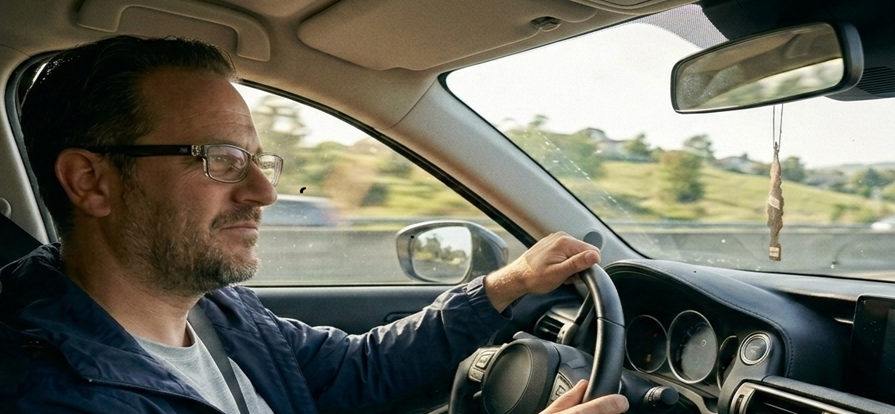
The night before a long drive, I charged every device in the house, made sure that each kid had their own headphones. I even loaded a few shows on the tablet just in case wifi was spotty. I’ve done this before every family trip for years.
Ironically, my professional life is spent researching exactly what children lose when we solve their boredom with a screen.
When I finally noticed the contradiction, I didn’t find it funny. I found it unsettling because if I, someone who understands this, who researches it, believes it still reaches for the devices, then the argument that parents just need more awareness seems a bit hollow. The pull isn’t ignorance, it’s something else.
I know this because I’ve been on the other side of it.
It’s 1987. We’re packing the car for the eight-hour drive to visit my grandparents.
At the beginning, everyone is excited. The trip feels like an adventure. We pile into the car with snacks, pillows, and the vague optimism that eight hours won’t feel quite that long.
Fast forward three hours.
We’ve played every car game we can think of. I’ve already fought with my siblings at least three times. My dad has threatened to pull the car over twice.
And with five hours still remaining, there’s suddenly nothing left to do.
So I stare out the window.
For a while I count cars or road signs. Eventually even that gets boring. And when boredom settles in long enough, something else starts to happen.
My mind wanders.
I imagine conversations, replay things that had happened at school, invent stories, or picture what the rest of the trip might look like. Somewhere between road signs and daydreams, the time slowly starts to pass again.
The boredom felt excruciating and daydreaming was how my brain dealt with it.
I remember wishing there was something—anything—to make the time pass faster. But those long stretches of staring out the window were doing something important.
When the brain isn’t occupied by external stimulation, it begins to turn inward. Psychologists refer to this as activation of the default mode network, a system in the brain that becomes active when we’re not focused on a specific task. You can think of it as the brain’s background processing mode. During these moments, the mind begins to wander. It replays memories, imagines future possibilities, connects ideas, and experiments with stories and scenarios. This is why people often report having their best ideas while walking, showering, or staring out a window. What appears to be idle time is often when the brain is quietly doing some of its most integrative thinking.
Today, however, boredom rarely lasts long enough for that process to begin. When the first signs of restlessness appear, there is almost always a device within reach, something to watch, scroll, or play. The moment of discomfort disappears almost instantly.
And when boredom disappears too quickly, the mental space where imagination and self-directed thinking begin has far less opportunity to emerge.
What Boredom Actually Is
When a child says “I’m bored,” it’s usually treated as a problem to be solved. Adults often respond by suggesting an activity, turning on a screen, or stepping in to provide entertainment. If I ever said that I was bored when my mom was around, she would suggest that she could find several chores around the house, which helped me find other things to do on my own. It worked, being outside riding my bike seemed way more appealing than whatever she would come up with.
Boredom isn’t an experience that should be avoided. Boredom occurs when stimulation is low, novelty is missing, and attention is not being pulled in any particular direction. The brain is essentially saying: there is nothing capturing my attention right now.
That lack of stimulation does feel uncomfortable. It motivates us to do something about it. Restlessness starts to build, time seems to drag on forever, and our minds start searching for anything to engage with to relieve the tension.
As boredom continues, we start asking ourselves questions such as, “What could I do?”, “What might be interesting?’, “What can I explore, imagine, or create?”. Sometimes that leads us to doing something such as playing a game, having a conversation. Other times, it turns inward towards imagination or daydreaming. Regardless of what we choose to do, this moment is critical. It's the moment when the mind begins to move from passive consumption toward active, self-directed thought and behavior.
Why Boredom Doesn’t Happen Much Anymore
For most of human history, some boredom was unavoidable. Waiting rooms were quiet, car rides were long, lines moved slowly. If there was nothing happening around you, you had no choice but to endure it. Those moments weren’t always enjoyable, but they were quite common. Boredom was an unavoidable part of everyday life.
Today, however, many of those moments of inevitable boredom have disappeared. When I feel even a slight twinge of boredom, my phone comes out. If I am in a grocery store line, I check my texts, emails, check to see if I have any notifications. Within seconds, my phone can provide endless content.
In many ways, this is remarkable. Digital tools have made information, entertainment, and connection instantly accessible. They’ve increased productivity and provided learning opportunities that previous generations could not have imagined.
But with those benefits, our technology has also changed something with respect to our relationship with discomfort and our willingness to tolerate boredom. In the past, boredom often lasted long enough to motivate us to begin searching for something to do.
Today, instead of asking “What can I do to relieve this boredom?”, my brain already knows that a quick escape is available by just pulling my phone out. My brain has learned that it doesn’t need to generate its own ideas because something else has already been provided.
Over time, the nervous system adapts to the environment it lives in. If boredom is rarely experienced, the willingness to sit with it decreases. If stimulation arrives instantly, the brain, instead, becomes accustomed to receiving stimulation rather than creating it.
What Children Lose When Boredom Disappears
For generations, periods of boredom acted as a developmental training ground. It created moments of tension that pushed children to invent games, explore ideas, or initiate action on their own. Over time, this helped build the skills that allowed children to learn to direct their own attention and motivation.
One of the first abilities affected by this change is self-directed activity. When children have to regularly resolve their own boredom, they begin to generate ideas: building something, drawing, exploring outside, or inventing games. When stimulation is always available, that process of internal problem-solving is less necessary. The choice to go outside instead of doing chores inside was the easy part. Then I had to figure out what to do. This led to exploration on my bike, climbing trees, testing my limits and finding out what things I enjoyed doing.
Another capacity that boredom is essential for is imagination. Daydreaming, storytelling, and creative play often emerge after the initial discomfort of boredom is endured. If boredom is short-circuited every time it begins to emerge, the transition from restlessness to imagination won’t happen as frequently. Survey stakes made great swords and provided hours of entertainment through imaginary battles.
Tolerance of boredom also helps to build persistence. When the brain has no choice but to tolerate boredom before something interesting happens, it strengthens the ability to stay with a task or problem. If the environment trains constant escape, the impulse to switch tasks rather than to persist becomes stronger.
I once built a tire swing with my brother but we didn’t want one down near the ground, we wanted one way up in a tree. Neither of us were strong enough to lift the tire into the tree so we had to figure out how to use ropes to lever it into place. We didn’t dare ask our parents for help as we were worried that they would tell us that we weren’t allowed to do it. So we stuck with it for hours and lots of failed attempts but we finally got it way up in the tree.
One of the most important skills that boredom can help children with is the development of internal motivation. If they have the opportunity to sit with and ultimately resolve their own boredom, children learn that they can initiate their own engagement rather than waiting for stimulation to arrive from outside. Nobody suggested we build that tire swing. Nobody checked on our progress or told us to keep going. That's what internal motivation looks like: a kid who has learned that engagement doesn't have to arrive from outside.
Protecting Boredom
If boredom once occurred naturally and now happens less often, the question becomes what we should do about it. The answer is not to eliminate technology or to romanticize the past. Digital tools have transformed how we learn, communicate, and solve problems. They are not going away, nor should they. But if boredom has developmental value, we may need to be more intentional about protecting it.
This begins with recognizing that boredom is not an emergency that adults need to jump in and fix.
When a child says, “I’m bored,” it is tempting to respond immediately with a suggestion, a solution, or a screen. In the moment, that response feels helpful. It relieves the tension quickly.
But boredom is often just the starting point of something important.
If the moment is allowed to linger, the mind begins to search. A child may eventually wander outside, start drawing, build something, or invent a game. The activity itself is less important than the process that leads to it. The child learns how to move from restlessness to engagement on their own.
Parents and adults can support this process in small ways.
1. Stop Treating Boredom as an Emergency.
When a child says, “I’m bored, “ our instinct is to fix it. My mother’s “fix” was suggesting chores, which I quickly learned to avoid by finding my own fun.
Strategy: Allow the moment to linger before jumping in to solve.
I remember a summer afternoon when my kids were young, no plans, nowhere to be. The complaints started almost immediately. I'm bored. There's nothing to do. I told them to figure it out, which took more restraint than I expected. An hour later they were outside with hammers, nails and some scrap lumber. They created something between a game and a construction project. I still don't know exactly what it was. I don't think it mattered.
2. Resist Filling Every “Quiet” Moment
We often use podcasts or tablets to “survive” car rides. But those quiet stretches are the primary breeding ground for connection.
Strategy: Allow silence to open the door.
My son and I drive to and from work together. Some of the best conversations I've had with him have happened in that car — the kind that wander into territory you wouldn't reach over a planned dinner or a scheduled catch-up. None of those conversations would have happened if we'd filled the drive with podcasts or audiobooks. The silence at the start of the trip is usually what opens the door.
3. Provide "Possibilities", Not Just Entertainment.
There is a profound difference between a toy that does something and a space that allows for something.
Strategy: Look for “loose parts” over “fixed play.”
Growing up on an acreage, we had woods, a slough, trees, and enough scrap lumber and old rope lying around to build almost anything. Nobody designed it as a play space. Nobody scheduled it. But we caught frogs in the slough, climbed everything climbable, dug holes in search of buried treasure that was never there, and built structures that probably weren't safe and definitely weren't approved. The space didn't provide entertainment. It provided possibilities. That distinction turns out to matter quite a bit.
4. Model Stillness
Children are astute observers. If every idle moment leads us to check our phones, we communicate to our children that stillness is something to escape. But when children see adults reading, thinking, walking, or simply sitting without immediate stimulation, they learn that quiet moments are not something to fear.
Sometimes the most valuable thing we can give children is not something new to do, but the time and space to figure it out for themselves.
Strategy: Show them that quiet isn’t a void.
I'm the one who stared out that window in 1987. I'm also the one who checks his phone in the grocery line before the first flicker of boredom has time to finish forming. Both of those things are true, and the distance between them is where this whole question lives.
I don't think awareness closes that distance by itself. But I do think naming the contradiction honestly is the only way we can begin to bridge it.
Productive Struggle in a Frictionless World
When friction disappears, we don’t just remove discomfort; we remove practice.
When I was in high school, calling a girl’s house was one of the most stressful experiences I had to endure.
There was no text, DM, or private line directly to her.
You called the family landline, hoping her dad wouldn’t answer.
But he always seemed to answer.
There was a pause.
“Hello?”
And that was usually the moment my voice cracked. I would speak too fast, trip over my own name, and become nearly unintelligible, which only made the interaction more awkward.
If I’m honest, had I had a cell phone back then, I would’ve texted her directly without hesitation. I would’ve gladly avoided that small but very real experience of social anxiety.
And it would’ve worked.
I would’ve spared myself the discomfort.
But I also would’ve spared myself something else.
I would’ve missed repeated practice speaking to adults who were, at best, indifferent to me and, at worst, judging me.
I would’ve missed the opportunity to regulate my voice when it shook.
I would’ve missed the experience of pushing through fear to accomplish something that mattered to me.
At the time, it felt like unnecessary suffering.
In hindsight, it was training.
When Friction Disappears, Practice Disappears
Since I was a child, many of these small moments of productive friction have been engineered out of daily life. Now there are digital off-ramps. We can bypass the waiting, filter the interaction, edit the message, and avoid the pause.
But when friction disappears, we don’t just remove discomfort; we remove practice.
In developmental psychology, we differentiate between toxic stress, tolerable stress, and positive stress.
Toxic stress is unpredictable, overwhelming, and unsupported. It involves prolonged activation of the body’s fight-or-flight response without the buffering protection of stable, supportive relationships. This kind of stress can be harmful.
Tolerable stress is more intense but temporary. It may involve events like a death in the family, an injury, or a serious illness. When buffered by caring relationships, even significant stress can be processed and integrated.
Positive stress, however, is different. It involves brief increases in heart rate and stress hormones. It’s the kind of stress that occurs when we try something difficult, speak in front of others, take a risk, or push through uncertainty. It’s a normal and necessary part of healthy development.
Productive struggle is contained discomfort. It’s the kind of tension that stretches and strengthens capacity without breaking it. It might look like: not knowing the answer right away; waiting longer than you want to; feeling awkward, but staying anyway; trying again after failing; or, sitting with boredom long enough for creativity to emerge.
Children today are not weaker than children in the past. They have grown up in an environment that allows them to avoid many of the daily discomforts that most of us had no choice but to live through. If they feel bored, there’s a device that can distract them immediately. If they feel confused, there’s a search engine. If they feel awkward, there’s an escape in their phones. If thinking feels like too much work, there’s AI.
Digital media has dramatically expanded access to information and increased productivity. But it has also created immediate escape routes from discomfort. Human brains evolved to be cognitive economizers. Whenever possible, we default to automation and effort reduction. This isn’t laziness; it’s efficiency. We automate repetitive tasks so that cognitive resources can be allocated to more complex thinking.
That process is essential for learning. The challenge is that digital tools now allow us to offload not just repetitive tasks, but effortful thinking itself, and the friction that once required us to persist is now optional. If waiting isn’t necessary, then patience disappears. If thinking can be outsourced, persistence declines. If social awkwardness can be avoided, then social skills atrophy.
Under-Practiced Skills, Not Moral Decline
When we frame these changes as moral failings, we corner ourselves into unhelpful conclusions.
We either lament “this generation” or we declare that phones and digital devices have ruined our children. And if that’s true, the only logical solution is elimination — remove the phones, ban the platforms, and hope the next generation can be spared.
But that solution is neither ethical nor realistic.
Digital media and AI aren’t disappearing.
If, however, we understand these shifts as under-practiced skills rather than moral decline, the path forward changes. Shorter attention spans aren’t evidence of weakness; they’re evidence of reduced rehearsal. Lower frustration tolerance isn’t a character flaw; it’s a capacity that has had fewer opportunities to develop.
When we see the problem this way, the solution becomes practical and hopeful. We need to reintroduce productive struggle. We do this not by manufacturing hardship or shaming reliance on technology, but by intentionally rebuilding the moments of effort, uncertainty, and mild discomfort that strengthen regulation, persistence, and social skills.
Intentionally Reintroducing Productive Struggle
If many of these learning opportunities have been engineered out of daily life, we cannot rely on our kids to build resilience accidentally. We have to reintroduce productive struggle intentionally by protecting small, manageable moments of effort and uncertainty that stretch capacity without overwhelming it.
Protecting Boredom
Boredom isn’t a problem to be solved immediately. It’s a neurological pause where the brain begins searching for stimulation, connection, or creation. When we rush to fill every quiet moment with a device, we teach the nervous system that stillness is intolerable. Eight-hour drives on family vacations as a kid were excruciating, but they also motivated me to daydream and to practice my imagination. We can allow boredom to linger long enough for discomfort to soften and initiative to emerge.
Building Wait Time Into the Process
Waiting is one of the most under-practiced skills of the digital age. But tolerance for waiting is directly tied to emotional regulation. I hate waiting for my food to come at a restaurant, but I can because I had to practice this as a kid.
We can rebuild patience in small ways:
Letting a child wait for help for a minute before stepping in.
Allowing minor delays without immediate distraction.
Resisting the urge to fix small inconveniences instantly.
It's a small thing. But small things, repeated often enough, become capacity.
Encouraging them to “Try One More Step.”
When I asked my parents questions as a kid, they often didn’t know the answer, so it was left to me to follow my curiosity to try to answer my own questions. It was often frustrating, but it taught me to persist even if the answers to my questions were not immediately available. Before jumping in to solve the problem for our kids or allowing them to Google or outsource to AI, you could ask them:
“What have you tried so far?”
“What’s a possible next step?”
“What do you think might work?”
This is not about withholding support. It is about scaffolding effort.
Allowing Safe Social Friction
Looking back, I wouldn’t volunteer to relive the terror of calling a girl’s house and speaking to her father. But I wouldn’t erase it either. Social skills only grow by engaging socially, and growth rarely happens in perfectly curated interactions.
Let children:
Order their own food.
Make their own phone calls.
Speak to adults.
Navigate minor misunderstandings.
These moments may feel uncomfortable, but they are rehearsals for adulthood.
Modeling
Perhaps most importantly, we can rebuild friction tolerance in our own behavior. Family dinners without digital media are often less relaxing because we actually have to interact, resolve differences, and listen to each other. But these are also some of the most important opportunities for children to connect with parents and learn from their behavior.
If we reach for distraction the moment we feel stuck, bored, or uneasy, we teach that discomfort is something to be avoided.
When we stay with a difficult task, finish what we start, tolerate awkward pauses in conversation, or resist the reflex to check our phones in every idle moment, we implicitly demonstrate that discomfort is survivable.
Conclusion
Those moments of productive struggle I experienced as a child didn’t damage me, but they did stretch me. They were small rehearsals in courage, regulation, and social skill development. Opportunities to tolerate awkwardness and to realize that I could do hard things.
Digital media did not make our children fragile. But it did make avoidance easier. And when avoidance becomes effortless, practice becomes optional. If we want capable, confident young people, we can’t remove every moment of discomfort, automate every pause, or eliminate every awkward interaction. Resilience isn’t built in crisis; it’s built in small, repeated experiences with discomfort that are safe enough to endure and supported enough to overcome.
What To Do When Your Child Is Stuck on Their Phone, and You’re Out of Answers
Does asking your child to put down their phone feel like starting a war? You aren't alone. When simple limits turn into explosive battles, 'just taking it away' often backfires. Here is why the conflict escalates, what an 'extinction burst' actually is, and how you can move from constant policing to building your child's capacity to cope without a screen.
If you're a parent of a child or teenager, this scene may be familiar.
You ask them to put their phone down.
They refuse.
You ask again.
They sigh, snap, argue, or shut down.
You take it away, or threaten to.
They blow up.
You see tears, anger, silence, and accusations that you “don’t understand.” When this happens repeatedly, it stops feeling like trying to set limits. It starts to feel like a battle. Many parents are left wondering whether they are being too strict, too permissive, or if it's simply too late to do anything.
In a recent post, I explained that many conversations about screens and AI focus on the wrong thing. We tend to treat technology as an object to manage by counting minutes, debating content, or worrying about what screens are replacing. From a developmental perspective, what matters more is what children are repeatedly practicing in these environments.
For many, this may make theoretical sense, but you may be asking yourself, how does it help me right now with the child in front of me who will not get off their phone and seems genuinely dysregulated?
Why “Just Take It Away” Often Makes Things Worse
When a child refuses to put down their phone, it is tempting to see the phone itself as the problem. From that perspective, the solution feels obvious. Remove the device, enforce the rule, regain control.
And sometimes that works briefly. Often it does not.
What many parents experience instead is that removing the device intensifies reactions. Distress does not subside; it escalates. The conflict becomes about much more than screen time.
This is not because the child is manipulative or defiant. And it is not because parents are doing something wrong. For many children, phones are no longer just a means of entertainment; they have become a coping mechanism.
Normal Does Not Mean Benign, But It Does Mean Explainable
These patterns are normal. They are an understandable response to environments designed to reduce discomfort and sustain anticipation.
But normal does not mean harmless.
When a phone becomes the default way a child regulates emotion, avoids effort, or manages uncertainty, it also means those capacities are not being practiced elsewhere. Over time, their phones become more necessary precisely because alternatives feel harder.
What Phones are Doing for Children
Digital environments don't just fill time. They shape learning through repeated patterns of relief, anticipation, and avoidance.
For many children, their phone becomes a powerful tool for managing internal states. It soothes boredom, anxiety, and emotional overload. It provides immediate exits from effort or uncertainty. It delivers a steady stream of notifications and possibilities.
When you remove the phone in these moments, you're not just taking away entertainment. You're removing their primary coping mechanism. That's why reactions can be so extreme.
Why Behavior Often Escalates Before It Improves
From a behavioral perspective, this reaction is not surprising. When a behavior has reliably worked in the past, for example, when picking up their phone has consistently reduced their boredom, anxiety, frustration, or uncertainty, and that behavior suddenly stops working, their brains start to panic. In learning theory, this pattern is referred to as an extinction burst.
Put simply, when an old strategy no longer produces relief, the nervous system escalates its efforts to get the same outcome. This escalation does not mean the behavior is becoming more entrenched. It means the nervous system is reacting to a mismatch between what it expects and what it is experiencing. The response intensifies because persistence has historically paid off.
For parents, this moment is often the most difficult. It feels like the limit itself is causing harm. But what the reaction is actually showing is how much regulatory work their phone has been doing and how little practice the child has had tolerating discomfort without it.
Escalation does not mean their phone is essential. It means their nervous system has not yet learned other, healthier ways of self-regulating.
Why This Reaction Makes Sense: A Familiar Analogy
It can help to step outside the parent-child dynamic for a moment and look at something we’ve all experienced.
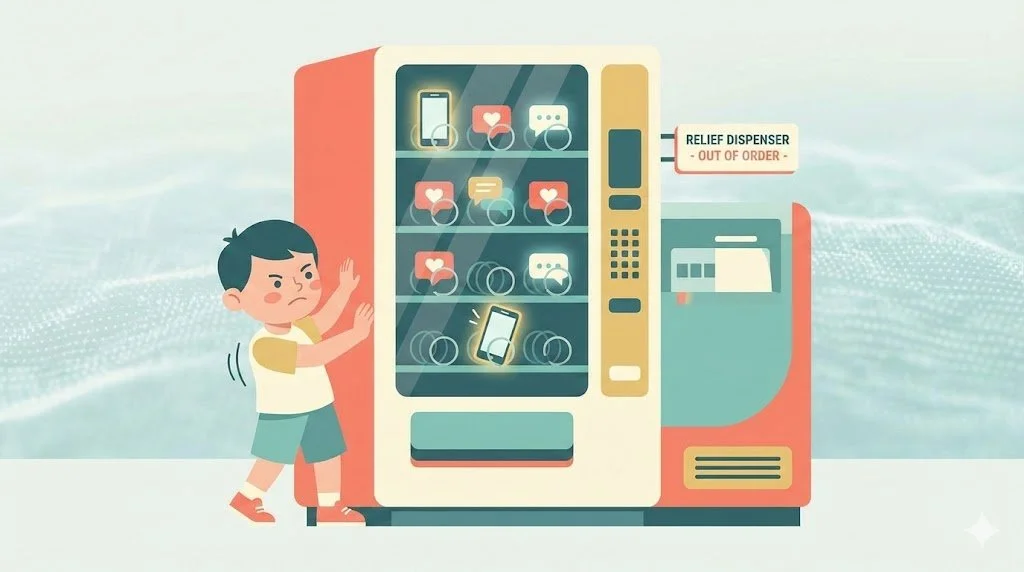
Imagine putting money into a vending machine. You press the button, and nothing happens. Most people do not just give up and walk away immediately. They press the button again. They press harder. They may even shake the machine. The behavior escalates not because the person is irrational, but because their expectation has been violated. Based on prior experience, pressing the button should produce a result, and when it does not, the system responds by trying harder. If the machine continues not to respond, frustration increases, and the behavior becomes evenmore intense.
Children respond in much the same way.
When picking up a phone has reliably reduced discomfort in the past and suddenly does not work (or is unavailable), behavior becomes more urgent and more insistent. This does not happen because the child is trying to be difficult; it happens because the strategy that usually works has failed.
How This Connects Back to Scaffolding
Seen this way, escalation is not a sign that something is going wrong. It is a signal that the nervous system is trying to solve a problem using the only strategy it knows.
Just as you would not expect a vending machine to dispense a snack once it stops working, you cannot expect a child to suddenly regulate, persist, or tolerate discomfort without support when their default strategy has been removed.
Understanding this learning pattern does not mean parents should ignore distress or push through protests at all costs. The goal is not to outlast your child. The goal is to recognize that escalation provides information about where support, scaffolding, and practice are needed.
If distress becomes overwhelming or unsafe, the goal may need to shift from strict obedience to first rebuilding regulation. Capacity building cannot happen when a nervous system is overwhelmed.
When This Approach Is Not Enough on Its Own
If your child’s distress is intense, persistent, or escalating to the point where daily functioning is breaking down, including sleep, school attendance, eating, safety, or relationships, this is not something to manage alone.
In those cases, phone struggles may be intertwined with anxiety, depression, ADHD, trauma, or other neurodevelopmental differences. Scaffolding and environmental shifts still matter, but they are not a substitute for professional assessment and support.
Seeking help is not a failure of parenting or of this approach. It is a recognition that some nervous systems need more support than families can provide on their own.
What Not to Focus on in the Moment
In the heat of these struggles, parents are often pulled toward instinctive responses. Escalating consequences. Arguing about screen time limits or labeling the behavior as addiction or disrespect. The problem with these responses is that they target the behavior without addressing the function.
A More Productive Shift: From Control to Capacity
This does not mean abandoning limits. It means shifting what the limits are for.
Instead of asking, “How do I get them off their phone?”
Try asking, “What is their phone doing for them that they do not yet know how to do without it?”
That question changes everything.
It moves the focus from winning a power struggle to identifying a skill gap, and from enforcing compliance to supporting development.
Instead of eliminating their phone use, the goal should be to make their phone less necessary over time.
What Scaffolding Can Look Like in Real Life
Consider a familiar situation.
A student comes home after a long day and is asked to start homework. Within minutes, she is on her phone. When a parent intervenes, she becomes irritable and insists she needs a break. Her phone gets taken away, but the distress escalates.
From a rule-based perspective, the question is whether her phone should be allowed.
From a capacity-based perspective, a different question emerges. “What is her phone helping her manage right now?”
In this moment, her phone may be doing several jobs at once: providing relief from cognitive fatigue, offering escape from uncertainty about where to begin, or supplying predictable engagement when effort feels hard.
Scaffolding does not mean giving her phone back; it means temporarily supporting the skill that is not yet strong enough to stand on its own.
That support might look like helping her identify the first small step, sitting nearby while she gets started, naming the discomfort out loud by saying “This feels hard to begin,” or creating a short, defined work period before any transition.
None of these moves eliminates the challenge; however, they reduce the load just enough for learning to begin.
Over time, the goal is to support the child until her phone becomes less necessary, not because it is forbidden, but because she has other ways to tolerate effort, uncertainty, and frustration.
The same pattern often appears outside academics.
A child may retreat into their phone after a difficult social interaction, an awkward lunch period, or feeling excluded by peers. In those moments, their phone provides distance from uncomfortable emotions and quick relief from social uncertainty. When their phone is removed, emotional intensity can spike.
Here, again, the focus should not just be on screen time. It is about slowly building tolerance for emotional discomfort and supporting regulation without immediate escape.
What Does This Change About Your Role as a Parent?
Seen this way, your job is not to be the screen police. It is to be a capacity builder.
That means paying attention to when and why phones become most problematic: transitions, homework, social stress, unstructured time, or moments of uncertainty or effort.
It also means recognizing that distress during removal is not proof that limits are wrong. It is information about where support and practice are needed.
How this looks will vary by age. Younger children often need more external structure and co-regulation in the moment. Adolescents may benefit more from reflective conversations outside the heat of conflict. The principle remains the same. Build capacity at the edge of what the child can manage, not at the point of being overwhelmed.
This work is slow and often uncomfortable. But small shifts matter more than they might seem. A child who waits three minutes before reaching for their phone, or who tries homework for five minutes before needing a break, is practicing something new. Over time, these small gains can add up.
What You Might Try Today or This Week
If you are currently experiencing daily phone struggles, start small. Don’t try to fix everything at once, and don’t worry about perfection; shift the direction of learning.
You might begin by noticing before intervening. For a few days, just observe when phones become most problematic.
You can name the feeling instead of focusing on behavior. Saying “This looks hard” or “That transition feels tough” often lowers intensity enough for learning to begin.
You could narrate your own struggles with discomfort and phone use. Modeling awareness ("I'm reaching for my phone because this feels hard") normalizes the pattern you're trying to change.
You might look for ways to reduce the emotional and/or cognitive load before reducing phone usage. Helping a child identify the first step, staying nearby briefly, or shortening the initial demand can make beginning a task more manageable.
If patterns change, expect escalation and do not panic when it happens. Escalation does not mean you are failing. It means the system is adjusting to uncertainty. Hold steady through it; the intensity typically subsides within days to weeks as new patterns take hold.
For older children and teens, it can also help to share understanding directly. "Your brain has learned that your phone helps you feel better quickly. That's not wrong, it's just that we want to help your brain learn some other ways too, so you have more options." This isn't about convincing them their phone is bad. It's about building a shared understanding of how phones and brains interact.
Finally, think in terms of practice rather than outcomes. Instead of asking how long they spent on their phone, ask what they practiced today.
You do not have to do this perfectly for it to help. Even small shifts can change learning over time. If you are parenting with a partner, it can help to share this framework explicitly so you are aligned on what you are building toward, even if you do not agree on every rule.
A Final Word of Reassurance
If you are dealing with a child who will not get off their phone and seems genuinely dysregulated, it does not mean you have failed. It does not mean the situation is hopeless. And it does not mean the only options are total restriction or total surrender.
Development remains plastic, especially during periods of active growth. Coping can be learned, regulation can be strengthened, and environments can be reshaped to support that process.
Remember: When you set a new limit and behavior gets worse before it gets better, you're not failing. You're watching an extinction burst, a normal part of how learning systems adjust to change.