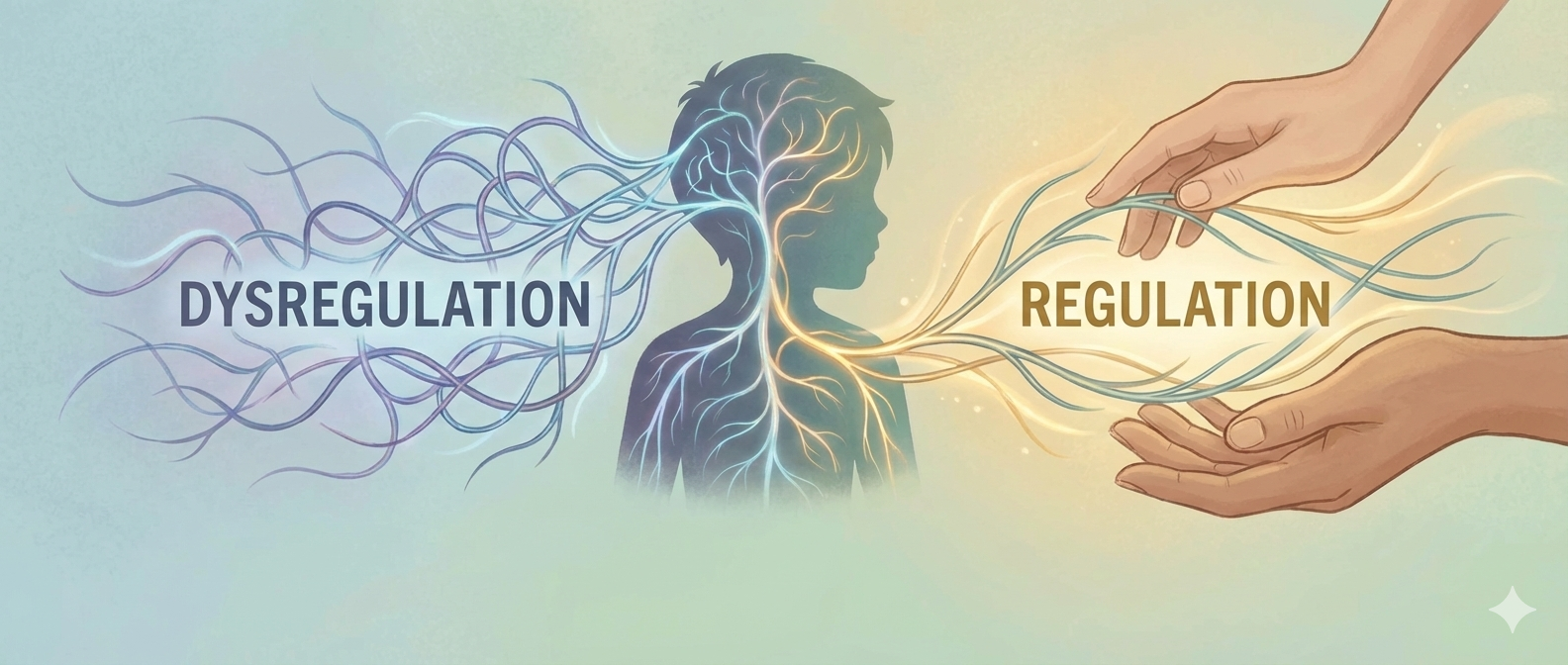
We’re Not Raising Addicted Kids. We’re Raising Dysregulated Nervous Systems.
Children aren’t addicted to screens. They’re navigating a world that overwhelms developing nervous systems. When we shift the conversation from fear to regulation, we stop trying to control behavior and start building the skills children actually need to recover, adapt, and grow.
When we talk about children and screens, the word addiction often comes up. It’s a powerful word. It signals urgency. It tells us that something is wrong, and, when it comes to our kids, sometimes it really feels like a crisis. But it also narrows the conversation in ways that don’t help us understand what’s actually happening, or what we can do about it.
If we look really closely, most children are not addicted in the clinical sense. What we are seeing instead is something more developmentally predictable: immature nervous systems interacting with environments that are fast, stimulating, emotionally charged, and easy to escape into.
This matters because children are still learning how to regulate attention, emotion, frustration, and boredom. Digital environments don’t just occupy those systems; they train them. When high-intensity input meets limited regulatory capacity, dysregulation becomes likely, even inevitable.
This isn’t about blaming screens, and it isn’t about blaming parents or kids. It’s about recognizing that the problem is not simply how much time children spend with technology, but how those experiences shape their ability to tolerate discomfort, recover from stimulation, and stay present when things feel hard.
If we simply frame this as addiction, we tend to focus on fear and restriction. If, however, we frame it as regulation, we can actually build skills.
Why “Addiction” Is an Understandable, but Limited, Frame
Addiction language resonates because the behaviors are real. Parents see emotional blowups, resistance when devices are removed, and a strong pull toward screens. From the outside, it can look compulsive. But addiction language assumes a fully developed regulatory system that has gone off track.
Children don’t have fully developed regulatory systems yet. They are still learning how to downshift after stimulation, how to tolerate boredom, how to sit with frustration, and how to recover from emotional intensity. When those systems are overwhelmed, children don’t look addicted; they look dysregulated.
Calling this addiction can unintentionally shift the goal from skill-building to control. While control can work in the short term, it rarely builds the internal capacities children need in the long run.
What Developing Nervous Systems Are Learning in Digital Environments
Digital environments are not neutral. They are designed for speed, novelty, emotional activation, and immediate relief. For a developing nervous system, repeated exposure to these patterns teaches powerful lessons:
• discomfort can be escaped instantly
• attention should shift quickly
• intensity is normal
• relief should be immediate
Over time, this changes what “normal” feels like, so when children then encounter slower, quieter, more effortful experiences, such as schoolwork, conversations, waiting, and problem-solving, their nervous systems register those moments as uncomfortable or even intolerable.
This happens, not because something is wrong with children, but because their system has been trained for something else. This is evidence of learning, not pathology.
It’s also important to say this clearly: dysregulation is not always just a developmental phase.
When emotional reactivity is extreme, persistent, or escalating, such as when a child cannot recover between episodes, when daily functioning is breaking down, or when distress is spilling into sleep, school, relationships, or safety, professional support matters.
Framing most struggles as regulation does not mean ignoring red flags. It means understanding when guidance at home is enough and when additional support can help stabilize a system that is overwhelmed.
It’s Not Just Screens—It’s How Children Use Them
One of the biggest problems with alarmist conversations about technology is that they oversimplify everything into a single point of exposure. Not all screen use trains the nervous system in the same way.
There is a meaningful difference between:
fast, solitary, high-arousal use and slower, shared, interruptible use
using screens to escape distress and using them as part of a broader, regulated day
constant switching and sustained engagement
The same device can either strain regulation or support it, depending on how it’s used and what surrounds it. When we reduce the conversation to “screens are the problem,” we miss the opportunity to guide children toward healthier interaction patterns and to build self-regulation skills.
Why Alarmist Language Backfires Over Time
Fear-based messaging creates urgency, but rarely fosters growth. When parents are told that screens are hijacking their children’s brains, the natural response is anxiety, guilt, and overcorrection. That often leads to rigid rules or screen bans without enough attention to regulation, transition, or recovery.
Children may comply or rebel, but neither response builds internal skills. Over time, alarmism can also exhaust families. When everything feels like a crisis, it becomes harder to tell what actually deserves attention. A regulation-based frame doesn’t remove limits; it makes limits developmentally meaningful. This isn’t an argument against limits; it’s an argument for limits that teach regulation rather than avoidance.
Regulation Is Built Through Staying, Not Escaping
Emotional strength isn’t built through comfort; it’s built through staying with boredom long enough for creativity to emerge, staying with frustration long enough for problem-solving to kick in, and staying with social awkwardness long enough for confidence to grow.
Digital environments make leaving easy. Here’s the part that is often missed: banning screens can become another form of leaving.
When the primary response to dysregulation is removal (e.g., take it away, shut it down, avoid the trigger), children don’t actually get more practice staying with discomfort. They simply experience a different kind of escape, one imposed from the outside.
The nervous system still doesn’t learn how to settle. It just waits for the next exit.
When escape becomes the default response to discomfort, whether through screens or through rigid restriction, the nervous system gets less practice doing what it’s designed to do: recover.
This is why the issue isn’t screens themselves, but how often they interrupt the process of regulation before it can complete, and whether we help children stay long enough for that process to happen.
What “Staying” Looks Like at Different Ages
What staying looks like changes as children grow. The goal of building regulation is the same, but the way adults scaffold that process needs to match developmental capacity.
For young children (roughly ages 3–6), staying is mostly about co-regulation.
Young children don’t yet have the neurological capacity to calm themselves reliably. When screens end, the most important factor isn’t the rule; it’s the adult’s presence.
That often means:
staying physically nearby during transitions
naming feelings without rushing to fix them
allowing mild frustration or boredom while providing calm reassurance
At this age, regulation is borrowed. Children learn how to settle by feeling your nervous system alongside theirs.
For school-age children (roughly ages 7–11), staying becomes about stretching tolerance.
School-age children can handle short periods of discomfort, but they still need help staying a little longer than they want to.
That might look like:
encouraging “one more minute” before switching activities
helping them finish a task after screens end instead of escaping immediately
supporting problem-solving rather than stepping in too quickly
The goal isn’t to eliminate frustration. It’s to help them discover that frustration peaks and then passes.
For adolescents (roughly ages 12+), staying shifts toward shared responsibility.
Teens need opportunities to practice regulation with increasing autonomy, but still within relational boundaries.
That often means:
having conversations about how screens affect mood, sleep, and focus
helping teens notice patterns rather than imposing constant controls
setting limits collaboratively, with recovery and balance as the goal
At this stage, regulation grows through reflection, not surveillance. Teens learn best when adults stay engaged without hovering or withdrawing.
Across all ages, the principle is the same: we don’t remove discomfort to protect children; rather, we help them stay with it long enough to grow.
If You’re Feeling Overwhelmed, Start Here
If all of this feels like a lot, start small. Regulation grows through repetition, not overhaul.
First, slow one transition each day.
Pick a single moment when screens usually end and add five minutes of warning, presence, or narration. Sit nearby. Name what’s happening. Let the feeling rise and fall without rushing to fix it.
Second, protect one low-stimulation window.
Choose one predictable time, after school, before bed, during a car ride, where nothing immediately fills the gap. No lesson. No productivity goal. Just space for the nervous system to settle.
You don’t need to do this perfectly. You just need to do it often enough for your child’s nervous system to learn that discomfort can be tolerated and that recovery is possible.
The Point Is Practice, Not Perfect Limits
Children don’t learn regulation by avoiding discomfort. They learn it by encountering discomfort in doses they can manage, with adults who help them stay.
They don’t learn to manage screens by having them taken away every time things feel hard. They learn by practicing limits, transitions, and recovery over and over again until those processes become internal.
Screens don’t have to disappear for this to happen. But they do need to stop being the fastest means of escape every time a feeling shows up.
When we shift the conversation from addiction to regulation, from fear to function, we stop asking “How do we control this?” and start asking something far more useful:
What capacities are we helping children build for the world they actually live in?
Children are not broken. Their nervous systems are still developing, and with appropriate support, children show a remarkable capacity for adaptation and recovery.