AI Didn’t Break Learning, It Changed What Learning Feels Like
Digital media and AI promise clarity, speed, and effortless learning. But real learning has never worked that way. This article explores how AI reshapes what learning feels like—and why struggle, confusion, and effort still matter for deep understanding.
Why Effortless Learning Comes at a Cost
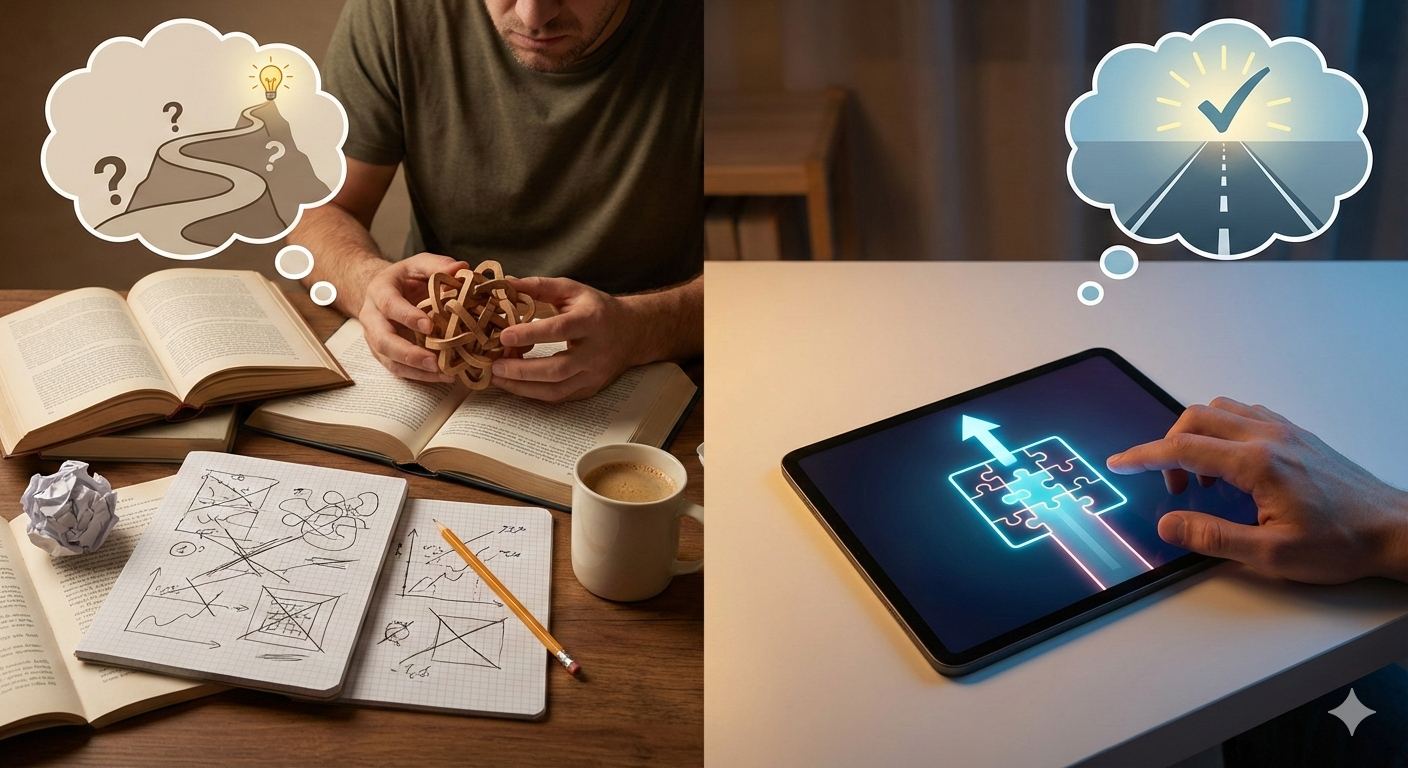
Digital media and AI tools deliver explanations with unprecedented speed and fluency. Confusion rarely lasts long. Uncertainty is quickly resolved. For learners, this can create the impression that learning should feel clear, efficient, and complete.
That impression is increasingly reinforced by companies promising effortless learning with tools that claim to optimize studying, eliminate struggle, and help students achieve top grades with minimal effort. The message is subtle but powerful: if learning feels hard, you’re doing it wrong.
But learning has never worked that way.
Real understanding develops through moments of uncertainty, revision, and effort. It often feels slower just as it starts to deepen. Confidence wavers before it stabilizes. Progress moves forward, then circles back.
What has changed is not how learning works, but the environments shaping what learners expect it to feel like.
Learning is non-linear
From a developmental perspective, learning is not the steady accumulation of information. It is a process of reorganization driven by moments of imbalance.
New ideas don’t simply add themselves to what we already know. Sometimes they fit easily. When they do, understanding feels stable, and effort is minimal. But other times, new information exposes gaps, contradictions, or limits in what we thought we understood. When that happens, the system becomes unsettled. Psychologist Jean Piaget described this state as disequilibrium.
Disequilibrium is the experience of realizing that something no longer quite makes sense. It is the cognitive tension that arises when existing ideas fail to fully explain what we are encountering. Importantly, this tension is not a problem to eliminate. It is the motivation that drives learning forward.
When understanding remains in balance, there is little reason to change. It is only when that balance is disrupted that the mind becomes motivated to adapt.
If new information can be absorbed without altering existing ideas, we assimilate it. Learning feels smooth and efficient. But when assimilation fails, the only way to restore balance is through a process called accommodation, by revising how we understand the world. That process is slower, effortful, and often uncomfortable.
Confusion, hesitation, and even temporary drops in performance are common signs that accommodation is underway. These moments are not evidence of inability. They are signals that understanding is being actively rebuilt.
Digital media flattens the learning experience
Online platforms are designed to feel clear, efficient, and continuously progressive. Information is broken into clean segments. Explanations arrive quickly, and progress is marked by completion rather than transformation.
These environments are highly effective at supporting early stages of learning, such as simple exposure, recognition, and basic understanding. They help learners encounter ideas, hear explanations, and develop familiarity. But deeper learning requires something different.
Deep learning requires applying ideas in unfamiliar situations, comparing perspectives, identifying limitations, and integrating new information with what is already known. These processes are often slow and unpredictable; they involve uncertainty, revision, and moments of doubt. They do not move neatly from one step to the next.
When learning environments emphasize speed and clarity, they create the impression that learning itself should feel smooth. When it doesn’t, learners are left to interpret the mismatch on their own.
Where AI fits into this picture
The rise of AI has brought many of these issues to the fore. Concerns about artificial intelligence in education often focus on misuse, students outsourcing work, bypassing effort, or relying too heavily on automated tools. Those concerns are understandable, but they miss a deeper issue.
The most significant impact of AI on learning is not that it provides answers, but that it resolves uncertainty too quickly. AI systems are exceptionally good at producing fluent explanations, polished summaries, and confident responses. The language is clear, the structure is sound, and the output looks finished. But clarity is not the same as comprehension.
From a developmental perspective, learning depends on disequilibrium, the moment when existing understanding is no longer sufficient. That cognitive tension is what pushes learners to question, revise, and reorganize their thinking. Without it, there is little motivation for learning to deepen. AI can interrupt this process by restoring a sense of equilibrium too early.
When an AI-generated explanation immediately smooths over confusion, learners may never fully experience the mismatch that would have driven accommodation. The system feels settled again, but understanding has not necessarily changed. The appearance of resolution replaces the work of reconstruction, making deep, transferable learning less likely to occur.
Over time, this can subtly reshape expectations. If learning consistently feels clear and complete, difficulty begins to feel like an error rather than an invitation to think. When challenges arise without AI support, they are more likely to register as failure rather than as a normal and necessary part of learning.
None of this means AI has no place in education. Used thoughtfully, it can extend thinking, offer alternative perspectives, and support reflection. The risk lies not in the tool itself, but in the way it can short-circuit disequilibrium and resolve uncertainty before learners have had a chance to learn from it.
When learning feels wrong, identity takes the hit
Developing learners are not just acquiring knowledge; they are forming beliefs about themselves as learners. They are constantly, often implicitly, asking questions like: Am I good at this? Do I belong here? What does it mean when this feels hard?
When difficulty arises in environments that suggest learning should be easy and linear, struggle is misinterpreted. Instead of thinking, This is challenging because I’m learning something new, learners are more likely to think, This is challenging because I’m not good at this.
Over time, this interpretation starts to erode persistence. Effort begins to feel like evidence against ability rather than a pathway toward it. Learners disengage not necessarily because they lack capacity, but because the experience of learning no longer matches what they have been taught to expect.
The problem isn’t effort, it’s expectations
When confusion or difficulty arises, digital environments offer immediate relief. Answers arrive quickly. Explanations smooth things over. Discomfort disappears. Over time, this creates a powerful learning loop: effortful struggle becomes something to escape, and rapid resolution becomes something to seek.
This pattern is quietly reinforced. Avoiding difficulty feels better in the moment, so it is more likely to happen again. The nervous system learns that confusion is a signal to disengage or outsource rather than to persist. What looks like low motivation is often a well-learned response to environments that reward escape over endurance.
Digital environments, and increasingly AI-supported ones, excel at delivering information quickly and clearly. What they struggle to convey is the value of confusion, revision, and slow understanding. When those elements are minimized, learning may feel more comfortable in the short term, but less durable in the long term.
This helps explain why learning can feel easier to access yet harder to sustain. The conditions that support deep, lasting understanding are replaced by conditions that reward immediate relief.
None of this means that digital learning, or AI, should be rejected. It does mean that we need to be more intentional about the expectations we set around learning.
Learning has never been smooth or predictable. It is effortful, uneven, and occasionally frustrating. Those experiences are not obstacles to understanding; they are part of how understanding is created.
When learners are supported in expecting confusion, tolerating pauses, and persisting through difficulty, learning regains its depth. Capacity does not need to be rebuilt. It is already there.
What needs rebuilding is our shared understanding of what learning actually looks like. If environments shape what learners avoid, they can also be redesigned to shape what learners practice.
Restoring the conditions for learning
If the problem is not capacity, but conditions, then the response is not to remove technology or demand more effort. It is to deliberately restore the experiences that learning depends on.
That starts with making room for productive discomfort again.
Here are some practical strategies that can begin to rebuild true learning:
Slow the moment of resolution.
When students encounter confusion, resist the impulse to immediately clarify or optimize it away. This might mean asking, “What part doesn’t make sense yet?” before offering help, or encouraging a learner to sit with a question for a few minutes before searching for an answer. The goal is not frustration, but familiarity with uncertainty.Use AI to extend thinking, not replace it.
AI is most helpful after learners have struggled, not before. For example, instead of asking an AI to generate an answer, students can be prompted to explain their current understanding first, then use AI to compare, critique, or refine it. This preserves disequilibrium while still benefiting from support.Make struggle visible and expected.
Teachers and parents can model this explicitly: “This part is usually where people get stuck,” or “If this feels confusing, that’s a sign you’re doing real work.” Naming the struggle as normal reduces the urge to escape it.Interrupt avoidance loops.
When learners habitually disengage at the first sign of difficulty, the response doesn’t need to be forceful. It can be as simple as encouraging one more attempt, one more question, or one more explanation in their own words before moving on. Small moments of persistence rebuild tolerance.Shift what counts as progress.
Progress does not always look like completion. It can look like better questions, clearer explanations of confusion, or more precise use of language. When these are recognized, learners begin to associate effort with growth rather than failure.Protect spaces where learning stays unfinished.
Not every problem needs an immediate answer. Leaving discussions open, returning to ideas later, or revisiting earlier misunderstandings teaches learners that learning is something that unfolds over time, not something that must be resolved instantly.
None of these practices eliminates efficiency or support. They simply rebalance it. They allow learners to start to experience confusion without panic, effort without shame, and difficulty without withdrawal.